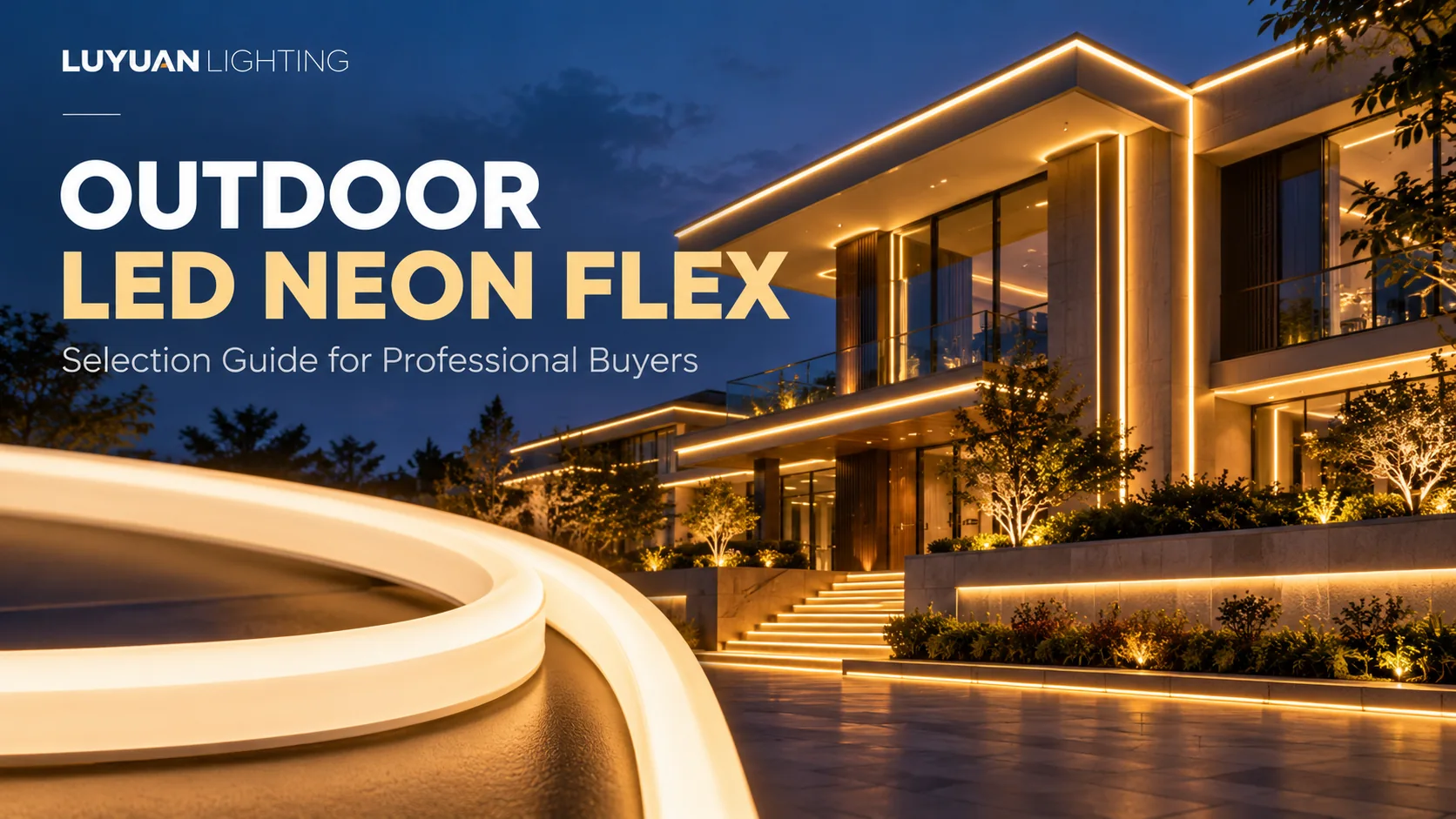
How to choose LED neon flex for outdoor projects depends on more than selecting a color and an IP number. A lighting shop, distributor or project buyer needs to match the light-emitting profile, voltage, exposure conditions, cutting intervals and installation accessories to the actual site. The wrong selection can create extra connections, uneven-looking bends or costly changes during installation.
This guide sets out a practical specification-first process for choosing LED neon flex for building outlines, exterior retail signs, landscape accents and other outdoor decorative applications. It uses real LUYUAN LIGHTING LED neon flex models as examples, while keeping product-specific ratings separate from general installation advice.
Quick Outdoor LED Neon Flex Selection Checklist
| Decision | What to check before ordering | Why it matters |
|---|---|---|
| Application | Building outline, signage, display, landscape or decorative accent | Determines viewing distance and required light direction |
| Exposure | Rain, splashing, cleaning, UV, heat, wind and condensation | The whole installed system must suit its environment |
| Profile | Width × height or diameter; visible side; bending direction | Determines whether the light follows the drawing |
| Electrical system | 12V / 24V / 220V model, driver, rated power and run length | Controls how the system is powered and connected |
| Layout | Cutting interval, sections, connections and mounting accessories | Prevents unsuitable cuts and unexpected seams |
| Wholesale supply | Colors, sample approvals, MOQ, packing and destination market | Helps suppliers prepare comparable quotations |
1. Start with the Outdoor Environment, Not Just the Catalog Photo
Make a list of the conditions where the LED neon flex will be installed. A sheltered fascia and an exposed rooftop are different environments. Ask whether the product will encounter direct rainfall, wind-driven water, cleaning jets, persistent sunlight, very high or low ambient temperatures, or contact with standing water. Identify whether the light will be installed horizontally, vertically or facing upward.
For any planned installation, request the product’s actual ingress-protection details together with the limitations of its connectors, end caps, cable exits and accessories. A product’s housing rating is not necessarily the rating of a cut-and-reconnected assembly. Ingress protection should be evaluated for the finished, installed configuration, not just a sample of uncut tubing.
LUYUAN’s published 6×12mm LED Neon Flex Light is listed as IP67. IP67 indicates a specified dust-and-water ingress protection classification under test conditions; it does not, on its own, promise indefinite underwater use or ensure that every field-made joint remains protected.
2. Choose the Light-Emitting Profile and Bending Direction
Neon flex is not a single shape. A slim rectangular cross-section can suit a narrow channel, while a larger profile may offer a more prominent visible line. A round-profile style can suit other decorative directions. The right option depends on the project drawing, mounting surface and the angle from which customers will see the light.
For example, LUYUAN lists 6×12mm, 8×16mm, 14×26mm and D16mm 360° neon flex configurations. These are separate models and should not be treated as interchangeable.
Ask the supplier to confirm the permitted bending direction and minimum bending radius of the exact model. A strip designed to bend in one direction may be damaged or look uneven if forced in another. For curved letters, corners and facade transitions, share a dimensioned drawing and request an installation sketch or sample of the bend.
3. Select the Voltage Using the Actual Electrical Design
Voltage choice influences the compatible power supply, wiring layout and installation method. Do not select voltage only from a simplified statement that one option is always better. The complete system must comply with the electrical rules and product approvals relevant to its destination market.
LUYUAN currently lists a 12V / 24V choice for the 6×12mm LED neon flex model and 220V on several other specific neon flex pages, including D16mm and 14×26mm models. These listings describe individual products—not a universal rule for an entire LED neon flex category.
Before ordering, confirm the nominal input voltage, expected operating current or power, compatible driver or mains connections, maximum supported length per feed, wiring method and any special termination parts. When the installation involves mains voltage, use qualified electrical personnel and the manufacturer’s model-specific installation instructions.
4. Understand LED Density, Uniformity and Color
Buyers often compare LEDs per meter, but that number alone does not determine the final appearance. The light’s diffuser, LED package, spacing, output and viewing distance all influence the perceived line. The published 6×12mm and D16mm LUYUAN examples both list 120 pieces of 2835 LEDs per meter; that does not mean the two models deliver identical optical performance.
For architectural contours, request illuminated close-up photos and a physical sample if uniformity or color matching is critical. Confirm whether the required color is warm white, white or another supported single color. If a project calls for RGB effects, addressable control or dimming, verify those functions against the exact product model rather than inferring them from the phrase “neon flex.”
5. Plan Every Run Around the Cutting Interval
A lighting drawing may show a perfect 2.35-meter segment, but the selected product may only permit cuts at predefined intervals. This can change the number of sections, feed points and connections needed. Map the exact lengths before agreeing on production quantities.
For LUYUAN’s 6×12mm model, the supplied specification lists 1cm / 3cm cutting intervals without clarifying which applies to the 12V or 24V configuration. Those details should be confirmed for the ordered version. Some of LUYUAN’s 220V neon flex models list a 100cm cutting interval; do not assume that shorter cuts are possible simply because the light is flexible.
Also request information about permissible run length, power injection where relevant, end sealing and factory-cut options. Never cut, splice or reterminate a powered or mains-voltage product without following approved instructions and appropriate electrical safety procedures.
6. Check IP Ratings, Connectors and Mounting as One System
Water ingress is not the only outdoor concern. The installation may also need resistance to ultraviolet exposure, temperature cycling, mechanical stress and appropriate strain relief. Confirm which requirements the manufacturer has tested or documented for the specific model and accessories.
Before release to production, specify the mounting clips or channel, any end caps, power connectors, cables, planned joint locations and the finish needed around cut ends. Ask whether the stated protection rating still applies after onsite assembly. Where regulations require independent certification or specific electrical protection measures, obtain documentation suitable for the destination market.
7. Compare Actual LUYUAN Models
The examples below are drawn from LUYUAN’s published product descriptions. They illustrate why the purchasing decision needs to happen at model level rather than category level.
| Product example | Published dimensions | Published voltage | Published IP | Buyer check |
|---|---|---|---|---|
| 6×12mm LED Neon Flex Light | 6×12mm | 12V / 24V | IP67 | Confirm cutting interval for chosen voltage |
| 8×16mm LED Neon Flex Light | 8×16mm | 220V | IP67 | Check available accessories and permitted bends |
| 14×26mm LED Neon Flex Light | 14×26mm | 220V | IP67 | Check mounting and cutting arrangement |
| D16mm 360° Neon Flex Light | D16mm | 220V | IP67 | Confirm viewing and installation orientation |
Specifications above are a quick reference, not a final approved installation schedule. Confirm current datasheets and the complete accessory configuration before placing an order.
8. Outdoor LED Neon Flex Wholesale Buying Checklist
- Drawings: Share measured site drawings, preferred light-line position and viewing direction.
- Environment: State exposure to rain, sunshine, cleaning, standing water and ambient temperature.
- Model: Specify dimensions, flexible profile, bending direction, light color and desired effect.
- Electrical: Confirm voltage, supply, power, wiring topology and local compliance needs.
- Lengths: Provide finished run lengths and verify permitted cutting intervals and connection points.
- Installation: Confirm clips, channels, sealed ends, cable routing and maintenance access.
- Order: Share estimated meters, packaging preferences, destination country, labeling and lead-time requirements.
- Approval: Request a sample or mock-up for critical profiles, color and bends before bulk production.
What to Ask LUYUAN LIGHTING Before Ordering
LUYUAN LIGHTING works with lighting shops, wholesalers, distributors and project buyers sourcing decorative lighting. Browse the LED Neon Flex Lights category to compare available models, then send your target voltage, profile, color, total length and destination market through the wholesale inquiry page.
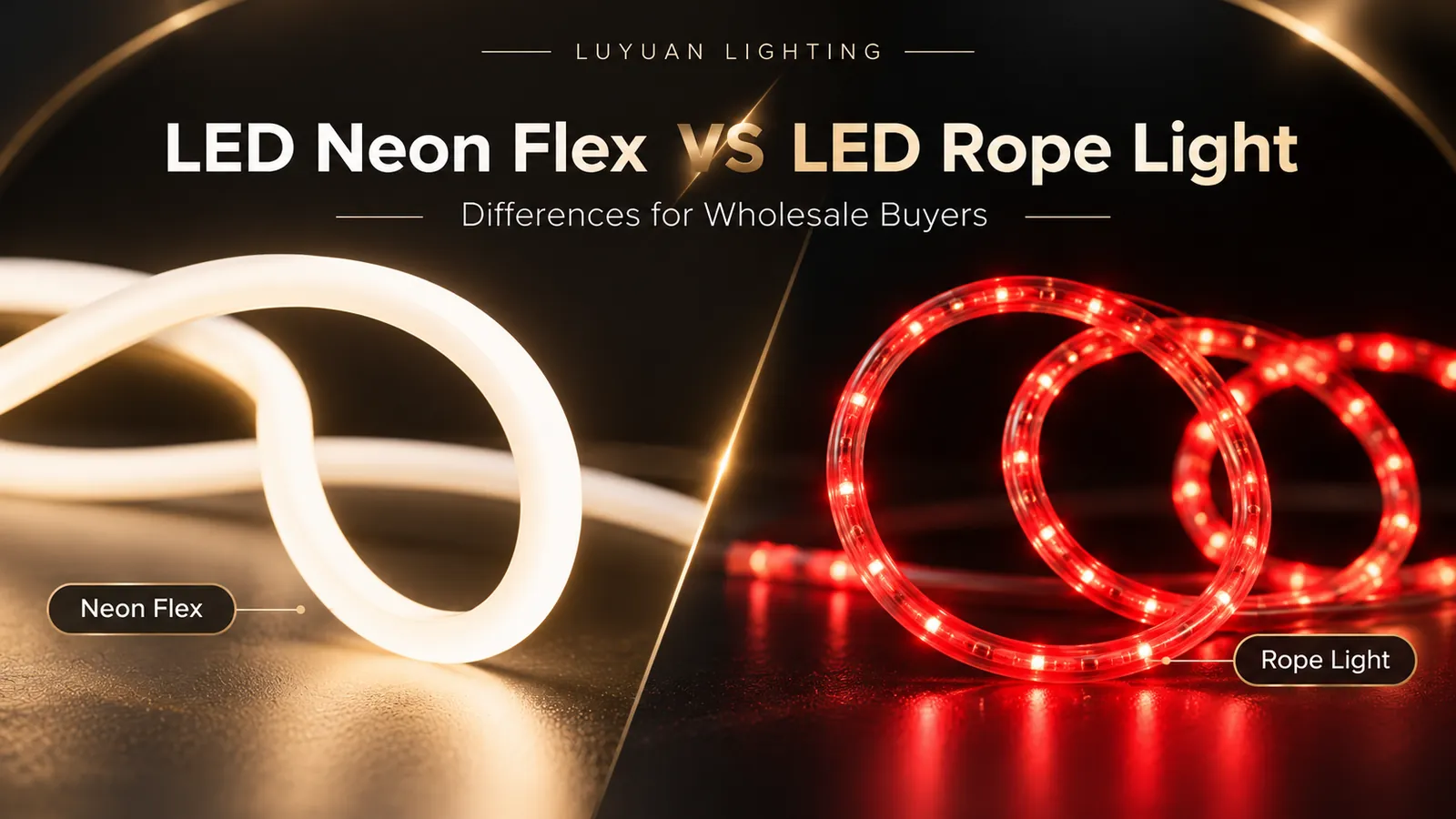
For additional manufacturing context, explore the company’s Factory Videos, including neon flex production and packaging. You can also read About LUYUAN LIGHTING for company information and see our earlier guide on LED Neon Flex vs LED Rope Light for a comparison of the two categories.
Request a model-specific quotation: provide the installation environment, dimensions, electrical requirements, quantities and artwork or drawings so specifications can be confirmed in writing.
Frequently Asked Questions
Is IP67 LED neon flex suitable for every outdoor lighting installation?
No. An IP rating describes protection under defined conditions and does not automatically certify every connector, end cap or field termination. Confirm the suitability of the complete system for the actual exposure.
Should an outdoor neon flex project use 12V, 24V or 220V?
That depends on the exact model, electrical design, compatible power supply, run lengths and local rules. LUYUAN lists 12V/24V and 220V on different models; no single voltage is ideal for every installation.
Can LED neon flex be bent around sharp corners?
Not necessarily. Each profile has a permitted bending direction and radius. Confirm both before designing tight curves or sharp returns.
Can you cut LED neon flex to any requested length?
No. Cutting positions are model-specific. Check the interval for the exact voltage and profile, and plan section lengths before ordering.
What information should a lighting distributor send for a quotation?
Send the model or profile size, voltage, LED color, quantities, run lengths, outdoor exposure conditions, destination market and any requested packaging or installation accessories.
Share your required product type, size, light color, voltage, IP rating, quantity and destination market with LUYUAN LIGHTING for specification and sourcing support.
Contact LUYUAN LIGHTING →