12V vs 24V LED neon flex is a practical electrical design decision, not a contest in which one voltage is always the better product. For lighting shops, importers, distributors and project buyers, the correct choice depends on the available power source, the number and length of illuminated sections, cable routes, dimming controls, and the specification of the exact neon flex model.
Both 12V and 24V versions can create the smooth, continuous luminous appearance associated with LED neon flex. What changes is the electrical system needed to achieve that result reliably. This guide explains the underlying differences and presents a quotation checklist using LUYUAN LIGHTING’s 6×12mm LED Neon Flex Light, which is listed with both voltage options, as a real product example.
12V vs 24V LED Neon Flex: Quick Comparison
| Selection point | 12V DC neon flex | 24V DC neon flex |
|---|---|---|
| Power supply | Needs a compatible regulated 12V DC supply | Needs a compatible regulated 24V DC supply |
| Current at the same wattage | Higher current | Half the 12V current, if the load power is identical |
| Feed-wire voltage drop | Greater current can increase loss for the same cable | Lower current can reduce cable loss for the same power and cable |
| Maximum single-feed run | Must be confirmed from its model datasheet | May allow a longer run, but never assume a universal distance |
| Cutting length | Depends on the actual internal circuit design | Depends on the actual internal circuit design |
| Brightness and visual quality | Not determined by voltage alone | Not determined by voltage alone |
| Common planning priority | Compatibility with an existing 12V system | Current and voltage-drop management across planned runs |
Bottom line: choose the voltage alongside the driver, cable size, controller and permitted run length. Never connect a 12V-only light to a 24V driver—or the other way round—unless a manufacturer has explicitly designed and rated the equipment for that configuration.
1. What Does 12V or 24V Actually Mean?
Both figures refer to the nominal input voltage of the applicable DC product. They do not directly state brightness, color quality, LED density, waterproofing performance or whether a product is suitable for a particular outdoor location.
Two neon flex products with the same visible dimensions can have different internal circuits, current requirements, allowable cutting points and connectors. A supplier should therefore quote a specific voltage version and matching accessories instead of treating “12V/24V” as a single interchangeable item.
For example, LUYUAN LIGHTING’s 6×12mm LED Neon Flex Light page identifies a 12V/24V option, a 6×12mm PVC profile, 120 pieces of 2835 LEDs per meter and an IP67 product rating. The same page lists a power value of 8–9W, but does not clearly identify whether this is per meter; buyers should request the actual wattage basis for their selected voltage and configuration.
2. Why Current and Voltage Drop Matter
For a comparable electrical load, power is approximately the product of voltage and current:
Power (W) = Voltage (V) × Current (A).
That means if two complete lighting loads each consume 48W, the theoretical input current is 4A at 12V and 2A at 24V. The example uses a hypothetical 48W load for illustration; it is not a stated LUYUAN neon flex rating.
| Illustrative 48W load | 12V system | 24V system |
|---|---|---|
| Nominal DC voltage | 12V | 24V |
| Load current (48W ÷ V) | 4A | 2A |
| If external cable-loop resistance is 0.15Ω | 0.6V drop (4A × 0.15Ω) | 0.3V drop (2A × 0.15Ω) |
| Wire loss at that resistance | 2.4W (I²R) | 0.6W (I²R) |
This simplified calculation illustrates why a 24V system can be attractive for some longer cable routes. The actual installation also includes circuit-board traces, connectors, controller losses and load variation. It is not a prediction of how far a particular strip can be powered.
Voltage drop can cause uneven output along a long installation. The appropriate remedy may be to revise cable size, split sections into shorter feeds, relocate the driver, add permitted feed points or change to a suitably designed product. Increasing driver wattage alone does not eliminate resistance in an unsuitable cable. For additional background, see this technical overview of voltage drop in LED strip systems.
3. Is 24V LED Neon Flex Always Better for Longer Runs?
No. Lower current at equal total power can be beneficial, but maximum single-feed length is a model-specific limit. It depends on conductor dimensions, wattage, internal circuitry, allowable brightness variation, ambient conditions and the manufacturer-approved wiring scheme.
Ask for the model’s maximum run per electrical feed, not merely the total length in a carton or roll. A 100-meter packaging roll is a logistics specification; it is not permission to operate 100 meters continuously from one power supply connection.
If a project contains a long facade with multiple curves, divide the installation drawing into actual powered sections. Record the location of each connection, any corners or mounting obstructions and the distance from the driver to the first segment. A distributor should then request a wiring sketch or written feed recommendation for the exact product.
4. Which Voltage Works Better with Existing Power Systems?
The most straightforward choice can be the voltage already approved for the installation. A retail display cabinet built around regulated 12V DC components may favor a compatible 12V neon flex model. Another project may use specified 24V controllers and driver infrastructure; in that case, a confirmed 24V neon flex version can simplify system matching.
Check the entire chain: AC mains supply to driver, driver output voltage, controllers or dimmers, connectors, polarity, lead cable, any required protective device and the neon flex itself. A device described only as “LED compatible” is not sufficient evidence that it works with every neon flex light.
Do not assume that “low voltage” automatically makes an installation safe in every environment. Power supplies, cable routing, driver locations, protective measures and installation personnel must comply with the applicable local requirements. Outdoor jobs also need suitable enclosure and connector protection.
5. Do 12V and 24V Products Have the Same Cutting Interval?
Not necessarily. The permissible cutting point comes from the product’s actual LED circuit and construction. Some voltage versions use different electrical groupings, but there is no universal rule that every 12V product can be cut more frequently than every 24V product.
LUYUAN’s 6×12mm product information lists 1cm / 3cm cutting intervals but does not assign those numbers to the corresponding 12V and 24V versions. A buyer should request a version-specific cutting diagram or marked physical sample before preparing cut lengths, particularly for lettering, signage and architectural corners.
Before purchasing, confirm whether factory-cut lengths are offered and how cut ends will be terminated. Field cutting and resealing can affect the installed ingress-protection performance. Use the manufacturer’s approved procedure and never modify a powered installation.
6. Does Voltage Change Light Output, LED Density or Color?
Voltage by itself does not determine how bright or uniform the neon flex will look. Buyers should compare LED type, LED density, power consumption, diffuser design, photometric information, viewing distance and the intended installation orientation.
The published 6×12mm LUYUAN model uses 120 pieces of 2835 LEDs per meter and lists Warm White, White, Red, Green, Blue and Yellow color options. That confirms the series’ stated LED density and color list; it does not establish identical brightness, color consistency or run length for every voltage and color.
If an importer needs close color matching across several batches, ask for samples under the same conditions and written requirements for color temperature, output tolerance, dimming compatibility and acceptance criteria. A product sample is especially useful when a project mixes different profiles or replacement sections.
7. Outdoor Projects: IP Rating Is a Separate Decision
A neon flex’s IP rating is not created by its 12V or 24V label. These are different kinds of specifications. Both voltage versions should be checked against the product’s stated housing protection and the protection of the installed connectors, cable exits and end caps.
The 6×12mm LUYUAN product is listed with an IP67 rating, but buyers should confirm whether this applies to the complete delivered assembly and whether field-made terminations preserve the specified protection. IP67 does not, by itself, authorize indefinite underwater installation or guarantee resistance to every outdoor condition.
For a broader outdoor selection checklist covering exposure, profile, bending direction and accessories, read our guide to choosing LED neon flex for outdoor lighting projects.
8. How to Choose: Three Practical Buyer Scenarios
Scenario A: A short decorative display with an existing 12V system
First verify whether a 12V version of the required profile is available and compatible with the existing driver/controller. Then confirm rated wattage, expected current, connector type, allowed cut points and cable run. This avoids replacing an otherwise suitable system just to change nominal voltage.
Scenario B: A long building outline with distant power supplies
Ask the supplier to compare the actual 12V and 24V electrical layouts using the drawing. A 24V option may help manage current in the feed cable at equal power, but each segment must still meet the approved maximum run and voltage-drop limits. Plan multiple feeds where required.
Scenario C: Outdoor curved letters or a detailed signage project
The profile’s bending direction, minimum bending radius, permitted cutting interval and sealed termination method may matter more than a general preference for one voltage. Request a sample of the exact voltage/profile variant and confirm whether all required segment lengths can be produced safely.
9. What Should a Wholesale Buyer Request Before Confirming an Order?
When requesting a comparable quotation for 12V or 24V LED neon flex, share a clear project brief with the supplier:
- Product identity: exact model, profile dimensions, emission direction, diffuser construction and requested light color.
- Electrical details: 12V or 24V DC variant, confirmed watts per meter or per segment, controller/driver compatibility and input tolerances.
- Layout: number of sections, cut lengths, cable distances, mounting orientation, bending direction and feed-point locations.
- Operating limits: maximum single-feed run, cutting interval, allowable voltage drop and connection requirements.
- Outdoor installation: verified IP rating, connectors, end caps, accessories, weather exposure and any destination-market requirements.
- Commercial requirements: estimated order volume, MOQ, color/batch matching, sample approval, packing length, delivery destination and lead time.
If a quotation lists only “LED neon flex 12V/24V” without the supporting version-specific details, request a clarified datasheet before approving the production order. For LUYUAN-specific quotations, review the LED Neon Flex collection and send your requirements through the wholesale contact page.
Questions Wholesale Buyers Ask About 12V and 24V Neon Flex
Can I power 12V LED neon flex from a 24V driver?
No, not unless the specific equipment is explicitly designed to accept that configuration. Match the manufacturer’s marked nominal input voltage and approved supply system.
Does 24V neon flex always use less electricity than 12V?
No. Electrical consumption is the load’s actual wattage, not its voltage alone. At equal watts, 24V draws less current, which can reduce loss in comparable feed conductors, but it does not automatically halve energy use.
Is 24V LED neon flex brighter than 12V?
Not inherently. Compare rated output, power, LED density, diffuser and the exact model’s performance data.
What run length can a 24V LED neon flex support?
There is no reliable universal distance. Request the manufacturer’s maximum run per feed for the specific voltage, profile, power, and wiring arrangement.
Does the IP67 rating depend on voltage?
No. Ingress protection concerns the tested construction and sealing, not the nominal supply voltage. Ask about the rating of the full installed configuration.
Does LUYUAN provide both 12V and 24V neon flex?
The published 6×12mm LED Neon Flex Light lists both 12V and 24V versions. Confirm the final power basis, cutting interval, color, connection parts and permissible run for the version you intend to order.
Conclusion: Specify the Whole Lighting System
When comparing 12V vs 24V LED neon flex, start with the system and the site rather than a universal “better voltage” claim. For equal-wattage loads, 24V requires less current and can ease some cable-loss problems. Yet a successful result still depends on the specific neon flex circuit, allowed powered run, driver, cabling, cutting scheme and final installed protection.
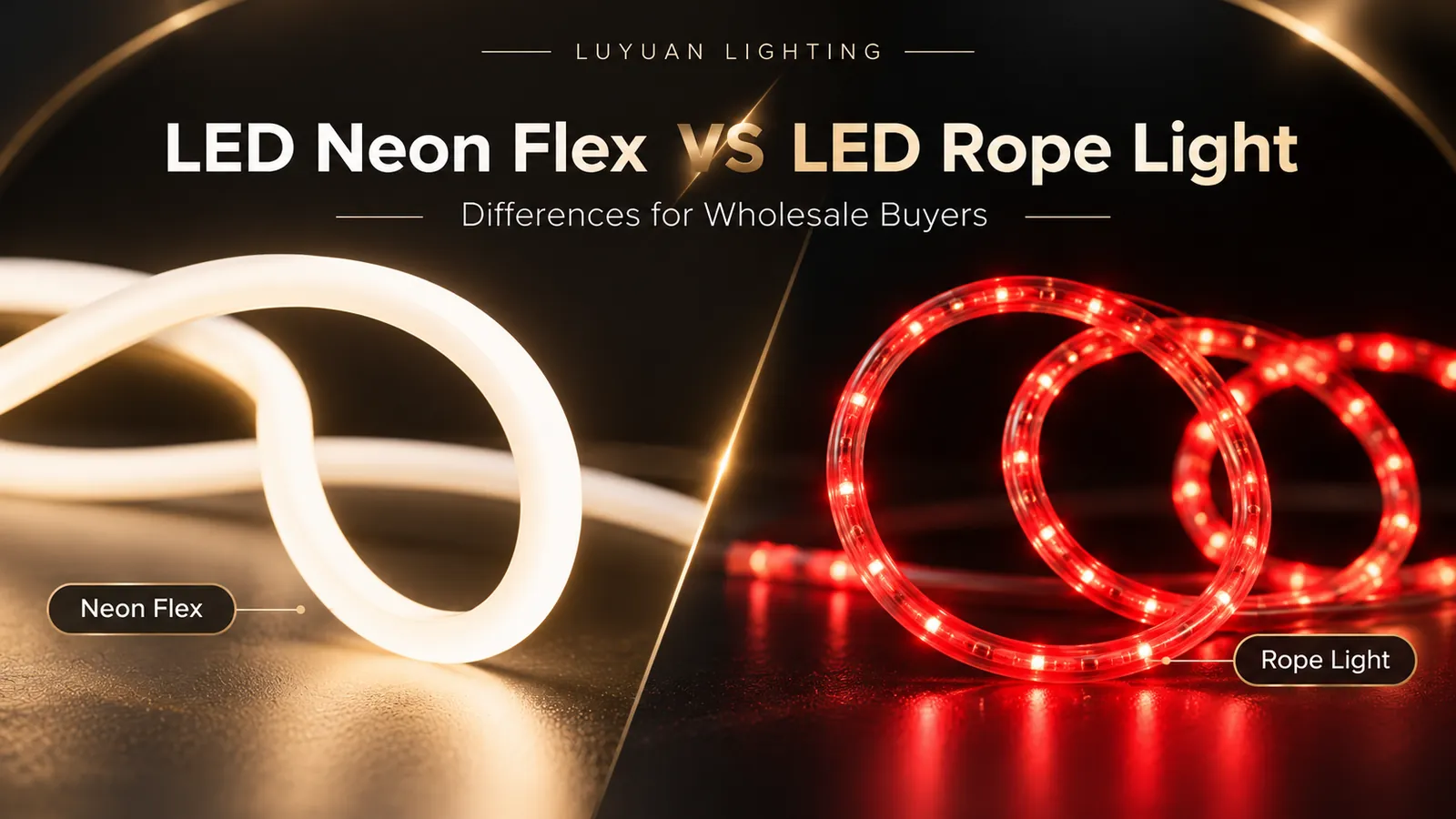
LUYUAN LIGHTING supports professional lighting shops, distributors, wholesalers and project buyers exploring decorative lighting ranges. See the difference between product categories in our LED Neon Flex vs LED Rope Light comparison, or send your project requirements to discuss suitable configurations and wholesale supply.
Share your required product type, size, light color, voltage, IP rating, quantity and destination market with LUYUAN LIGHTING for specification and sourcing support.
Contact LUYUAN LIGHTING →